University of Central Missouri
Here is a personalized summary of the current course requirements and recommendations for undergraduate elementary teacher candidates at University of Central Missouri, and a detailed analysis of the content covered by those requirements. This tool also offers a recommended set of courses providing the most content coverage for any candidate.
Catalog Year: 2021-2022
University of Central Missouri
This tool provides individual preparation programs with a customized analysis of the courses required by the undergraduate elementary teacher preparation program and by the institution’s undergraduate general education courses to determine how well these requirements cover essential content in science. This tool also uses information about existing coursework on their campuses to provide guidance on a recommended course sequence.
This is a summary of the coverage of science content for undergraduate elementary candidates at your institution.
To determine if an elementary teacher preparation program provides adequate coverage¹ in the primary subject area of science through its own requirements or the institution’s requirements, we ask three sequential questions exploring:
- Evidence of any science coverage;
- Evidence of coverage of the three science themes; and
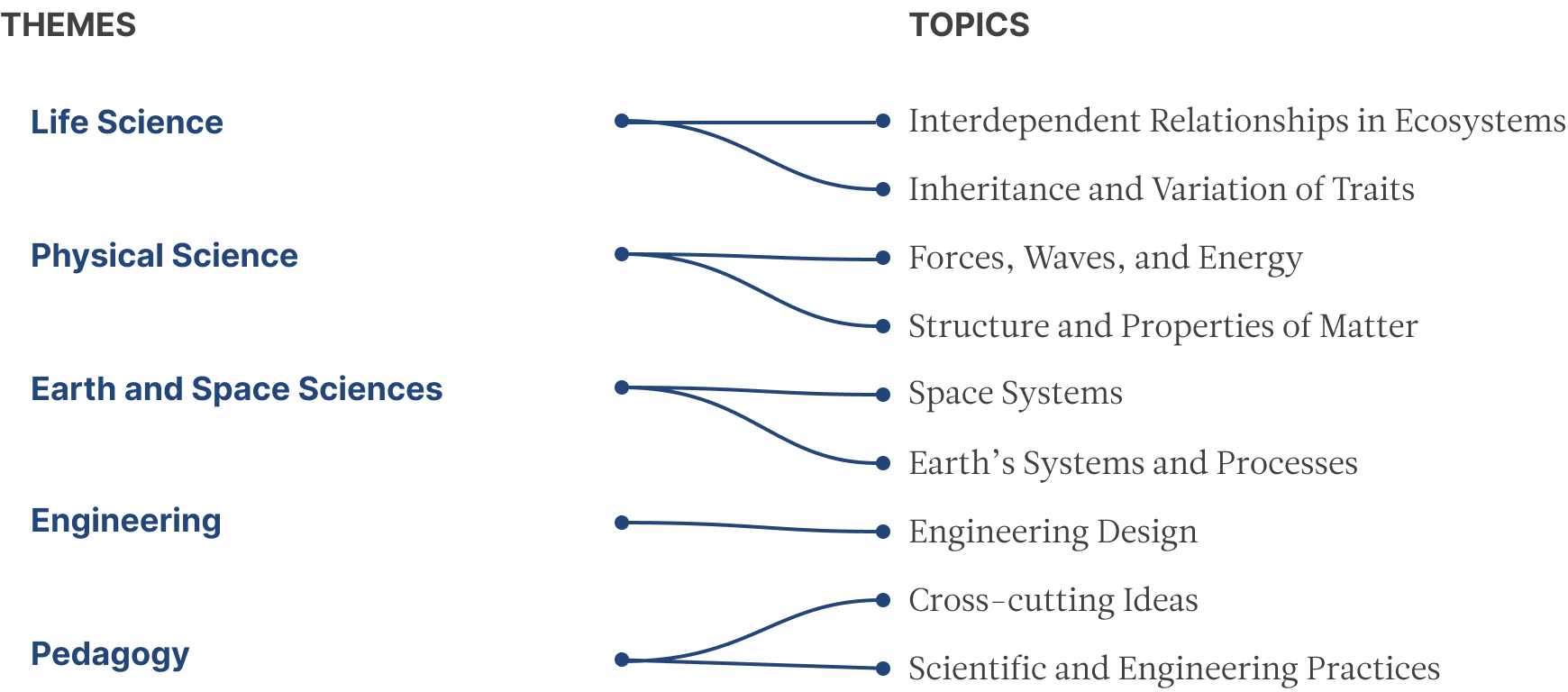
- Evidence coursework encompasses the nine topics of science knowledge required of elementary teachers.
University of Central Missouri's Coverage
Coverage of Subject
Does the institution or teacher preparation program require elementary candidates complete any courses in science?
The institution/program recommends or requires candidates to complete at least one course classified under the broad domain known as science.
The institution/program does not require or recommend candidates to complete at least one course classified under the broad domain known as science.
Theme Coverage
Within science, there are five themes. Does the institution or teacher preparation program require or recommend courses to ensure each of the themes classified under science are covered?
The coursework required or recommended for elementary candidates at this institution covers all five themes in science: 1. Life Science, 2. Physical Science, 3. Earth and Space Science, 4. Engineering, and 5. Pedagogy.
The coursework required or recommended for of elementary candidates at this institution does not cover all five themes in science: 1. Life Science, 2. Physical Science, 3. Earth and Space Science, 4. Engineering, and 5. Pedagogy.
Topic Coverage
Within the five themes of science are nine topics common to teaching elementary students. Does this institution or preparation program require or recommend courses to ensure each of the nine topics classified under science are covered?
Elementary education candidates at this institution must complete at least one course covering each of the nine topics.
Elementary education candidates at this institution are not required to take courses covering each of the nine topics.
What are the nine topics of Science content?
References
- For these purposes, credit for “coverage” is awarded to the program whether the course is mandated through general education requirements for the institution at large or the specific requirements of the educator preparation program.
Continue Reading
See a detailed course analysis for your institution.
This tool illuminates:
- What course options are available to satisfy general education or teacher preparation Requirement Categories;
- What courses are required or recommended, either through general education requirements or the teacher preparation program; and
- Whether courses cover the themes and topics of science content knowledge.
The aim of this tool is to provide an understanding of which courses are most likely to yield the most coverage possible of the content critical for elementary teachers. Because candidates can often choose from a list of courses to meet a Requirement Category, this table provides insight into which of those courses will be most relevant to elementary teaching.
How are Requirements Determined?
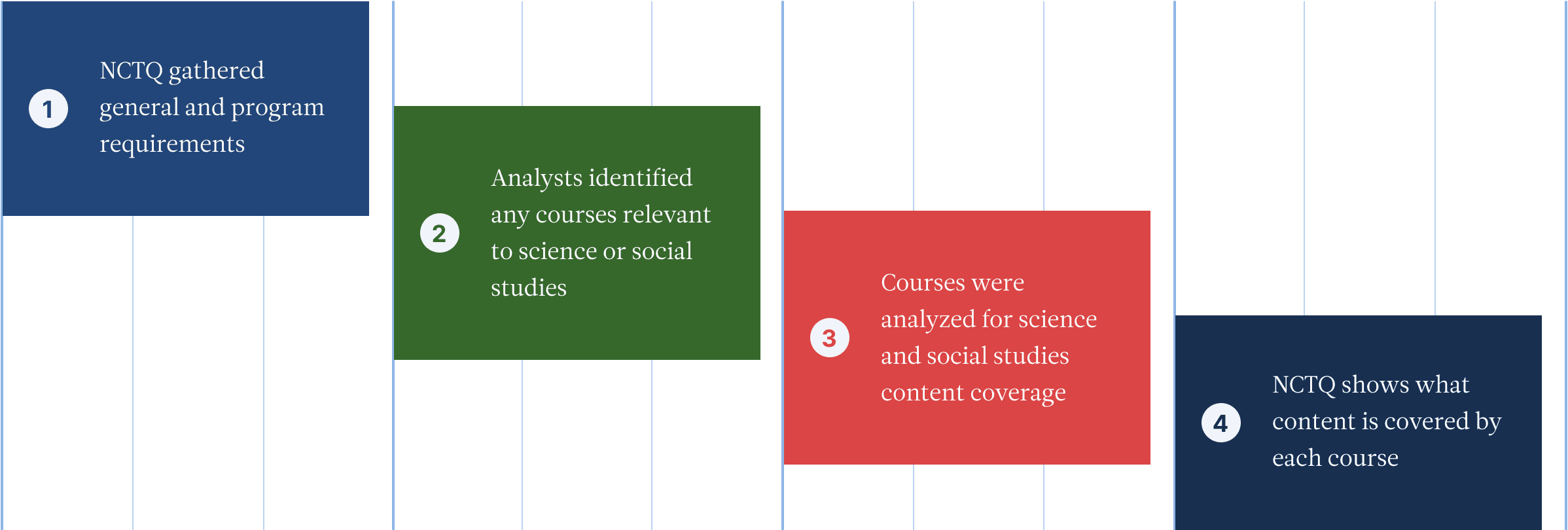
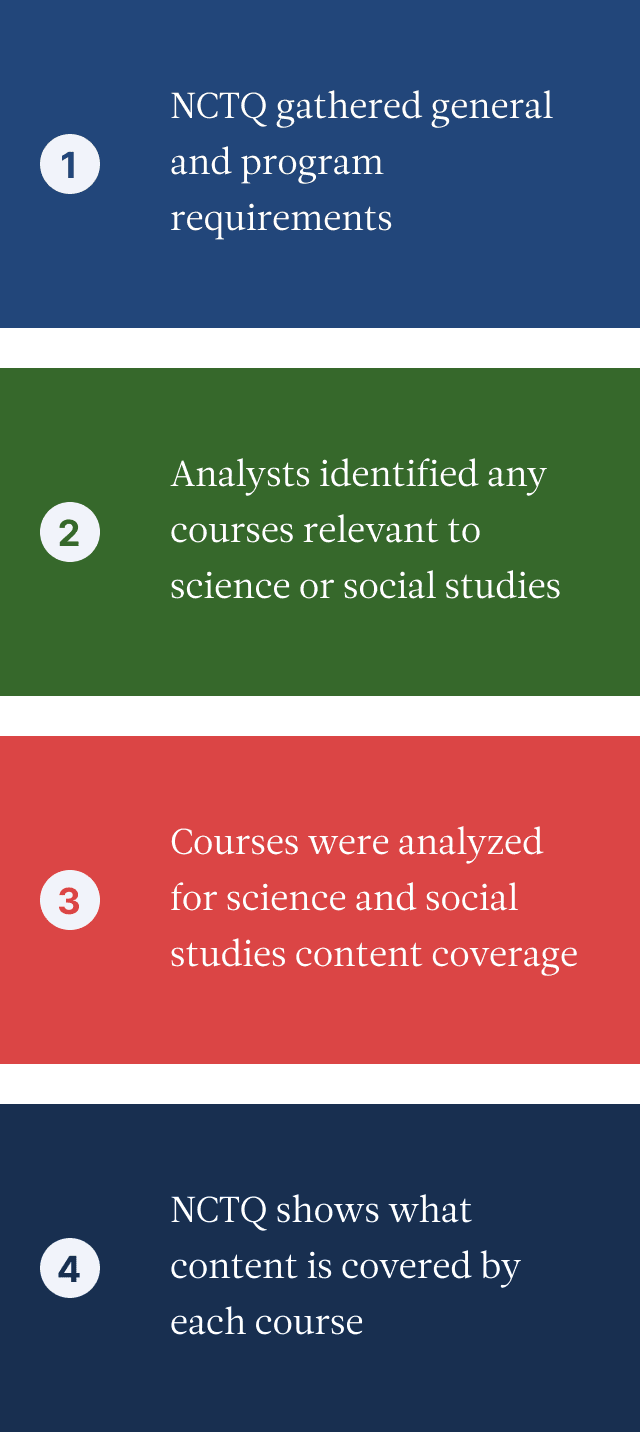
Analysts identify both the general education and program graduation requirements found in public-facing materials.
By reviewing each Requirement Category and available course options, analysts identify courses addressing science and social studies content relevant to elementary teachers. The course analysis table indicates what themes and topics each course covers.
University of Central Missouri's Content Coverage Analysis
Filter Course Options By Requirement Category
| Themes: | Pedagogy | Life Science | Physical Science | Earth & Space Sciences | Engineering | ||||
|---|---|---|---|---|---|---|---|---|---|
| Topics (hover to see name): |
ACross-cutting Concepts |
BScientific and Engineering Practices |
CInterdependent Relationships in Ecosystems |
DInheritance and Variation of Traits |
EForces, Waves, and Energy |
FStructure and Properties of Matter |
GSpace Systems |
HEarth's Systems and Processes |
IEngineering Design |
Extensive ListInstitution offers ten or more course options to fulfill requirement. Courses shown cover at least one applicable topic. |
|||||||||
BIOL 1004Introduction to the Sciences: Ecology |
|||||||||
CHEM 1104Introduction to the Sciences: Chemistry |
|||||||||
GEOS 1004Introduction to Geology |
|||||||||
PHYS 1101College Physics I |
|||||||||
Continue Reading
See the recommended course sequence for your institution.
Here NCTQ outlines (1) the set of courses providing candidates with the content most aligned with what elementary teachers need within current institution and program requirements, and (2) suggestions for courses to fill in gaps where candidates still lack coverage.
"Most Aligned" Set of Courses
-
Science Requirement 01
GEOS 1004 - Introduction to Geology
-
Science Requirement 02
ECEL 2610 - Life & Earth Science for Teachers
-
Science Requirement 03
ECEL 3610 - Science for the Young Learner
-
Science Requirement 04
ECEL 3620 - Science for the Intermediate Learner
-
Science Requirement 05
ECEL 2620 - Physical Science and Engineering Design for Teachers
-
Science Requirement 06
BIOL 1003 - Introduction to the Sciences: Ecology GE
How to Improve Content Coverage
Using the “Most Aligned” set of courses, current course requirements can address up to 100% of science topics.
To take full advantage of this, the program should provide explicit recommendations for prospective candidates to ensure they are taking courses that will give them the greatest breadth of coverage.
Analysis of Content Covered by "Most Aligned" Set of Courses
= Course is Currently Recommended or Required by Program
Download Recommendations| Themes: | Pedagogy | Life Science | Physical Science | Earth & Space Sciences | Engineering | ||||||||
|---|---|---|---|---|---|---|---|---|---|---|---|---|---|
| Topics (hover to see name): |
ACross-cutting Concepts |
BScientific and Engineering Practices |
CInterdependent Relationships in Ecosystems |
DInheritance and Variation of Traits |
EForces, Waves, and Energy |
FStructure and Properties of Matter |
GSpace Systems |
HEarth's Systems and Processes |
IEngineering Design |
||||
GEOS 1004Introduction to Geology |
|||||||||||||
ECEL 2610Life & Earth Science for Teachers |
|||||||||||||
ECEL 3610Science for the Young Learner |
|||||||||||||
ECEL 3620Science for the Intermediate Learner |
|||||||||||||
ECEL 2620Physical Science and Engineering Design for Teachers |
|||||||||||||
BIOL 1003Introduction to the Sciences: Ecology GE |
|||||||||||||
| Total Content Covered: 100% | |||||||||||||
If a candidate takes the above courses, this is the topic coverage they would experience overall: |
|||||||||||||
Catalog Year: 2021-2022
University of Central Missouri
This tool provides individual preparation programs with a customized analysis of the courses required by the undergraduate elementary teacher preparation program and by the institution’s undergraduate general education courses to determine how well these requirements cover essential content in social studies. This tool also uses information about existing coursework on their campuses to provide guidance on a recommended course sequence.
This is a summary of the coverage of social studies¹ content for undergraduate elementary candidates at your institution.
To determine if an elementary teacher preparation program provides adequate coverage² in the primary subject area of social studies through its own requirements or the institution’s requirements, we ask three sequential questions exploring:
University of Central Missouri's Coverage
Coverage of Subject
Does the institution or teacher preparation program require elementary candidates complete any courses in social studies?
The institution/program recommends or requires candidates to complete at least one course classified under the broad domain known as social studies.
The institution/program does not require or recommend candidates to complete at least one course classified under the broad domain known as social studies.
Theme Coverage
Within social studies, there are six themes. Does the institution or teacher preparation program require or recommend courses to ensure each of the themes classified under social studies are covered?
The coursework required of elementary candidates at this institution covers all six themes in social studies: 1. Civics, 2. Economics, 3. History, 4. Geography, 5. Culture & Identity, and 6. Pedagogy.
The coursework required of elementary candidates at this institution does not cover all six themes in social studies: 1. Civics, 2. Economics, 3. History, 4. Geography, 5. Culture & Identity, and 6. Pedagogy.
Topic Coverage
Within the six themes of social studies are thirteen topics common to teaching elementary students. Does this institution or preparation program require or recommend courses to ensure each of the thirteen topics classified under social studies are covered?
Elementary education candidates at this institution must complete at least one course covering each of the thirteen topics.
Elementary education candidates at this institution are not required to take courses covering each of the thirteen topics.
What are the thirteen topics of Social Studies content?
References
Continue Reading
See a detailed course analysis for your institution.
This tool illuminates:
The aim of this tool is to provide an understanding of which courses are most likely to yield the most coverage possible of the content critical for elementary teachers. Because candidates can often choose from a list of courses to meet a Requirement Category, this table provides insight into which of those courses will be most relevant to elementary teaching.
How are Requirements Categories Determined?
Analysts identify both the general education and program graduation requirements found in public-facing materials.
By reviewing each Requirement Category and available course options, analysts identify courses addressing science and social studies content relevant to elementary teachers. The course analysis table indicates what themes and topics each course covers.
View the Course Catalog
University of Central Missouri's Content Coverage Analysis
Filter Course Options By Requirement Category
Identity
A
Political institutions, Participation, Rules, and Laws
B
Economic Principles and Exchange
C
The Economy
D
European Exploration and Colonization (up to 1700)
E
The American Revolution and Founding (1700s)
F
Growth and Expansion of the American Republic (up to 1900)
G
Twentieth Century and Beyond
H
Pre-Columbian and/or Ancient Civilizations
I
Twentieth Century and Beyond
J
Geographic Representations
K
Human-Environment Interactions
L
Diverse Perspectives
M
Cross-cutting Concepts
Extensive List
Institution offers ten or more course options to fulfill requirement. Courses shown cover at least one applicable topic.
Extensive List
Institution offers ten or more course options to fulfill requirement. Courses shown cover at least one applicable topic.
Extensive List
Institution offers ten or more course options to fulfill requirement. Courses shown cover at least one applicable topic.
Extensive List
Institution offers ten or more course options to fulfill requirement. Courses shown cover at least one applicable topic.
Extensive List
Institution offers ten or more course options to fulfill requirement. Courses shown cover at least one applicable topic.
BIOL 1004
Introduction to the Sciences: Ecology
CHEM 1104
Introduction to the Sciences: Chemistry
GEOS 1004
Introduction to Geology
PHYS 1101
College Physics I
ECEL 2610
Life & Earth Science for Teachers
ECEL 3610
Science for the Young Learner
ECEL 3620
Science for the Intermediate Learner
ECEL 2620
Physical Science and Engineering Design for Teachers
BIOL 2510
Basic Genetics GE
BIOL 1003
Introduction to the Sciences: Ecology GE
ECEL 2110
Diversity and Social Justice GE
HIST 1400
History of the Early World
HIST 1401
History of the Early Modern World
HIST 1402
History of the Modern World
HIST 1351
History of the United States from 1877
HIST 1350
History of the United States to 1877
ECON 1010
Principles of Macroeconomics GE
ECON 1011
Principles of Microeconomics GE
GEOG 2212
World Geography
POLS 1510
American Government
ECEL 3510
Social Studies and Economics for the Young Learner
ECEL 2510
Concepts in Elementary Social Studies I
ECEL 3520
Social Studies and Economics for the Young Learner
ECEL 2520
Concepts in Elementary Social Studies II
HIST 1400
History of the Early World
HIST 1402
History of the Modern World
GEOG 2212
World Geography
ECON 1010
Principles of Macroeconomics GE
ECON 1011
Principles of Microeconomics GE
POLS 1510
American Government
HIST 1350
History of the United States to 1877
HIST 1351
History of the United States from 1877
EDFL 2240
Educational Psychology GE
Continue Reading
See the recommended courses for elementary candidates at your institution.
Here NCTQ outlines (1) the set of courses providing candidates with the content most aligned with what elementary teachers need within current institution and program requirements, and (2) suggestions for courses to fill in gaps where candidates still lack coverage.
"Most Aligned" Set of Courses
ECEL 2110 - Diversity and Social Justice GE
HIST 1350 - History of the United States to 1877
POLS 1510 - American Government
ECEL 3510 - Social Studies and Economics for the Young Learner
ECEL 2510 - Concepts in Elementary Social Studies I
ECEL 3520 - Social Studies and Economics for the Young Learner
ECEL 2520 - Concepts in Elementary Social Studies II
HIST 1402 - History of the Modern World
How to Improve Content Coverage
Using the “Most Aligned” Set of Courses, current course requirements can address up to 84.62% coverage of social studies topics.
The topics still lacking coverage include:
To improve content coverage, the institution or teacher preparation program may need to require additional courses for their candidates to achieve coverage across all topics. Our analysts identified the following courses to cover these topics:
Analysis of Content Covered with "Most Aligned" Set of Courses
= Course is Currently Recommended or Required by Program
Download RecommendationsIdentity
A
Political institutions, Participation, Rules, and Laws
B
Economic Principles and Exchange
C
The Economy
D
European Exploration and Colonization (up to 1700)
E
The American Revolution and Founding (1700s)
F
Growth and Expansion of the American Republic (up to 1900)
G
Twentieth Century and Beyond
H
Pre-Columbian and/or Ancient Civilizations
I
Twentieth Century and Beyond
J
Geographic Representations
K
Human-Environment Interactions
L
Diverse Perspectives
M
Cross-cutting Concepts
ECEL 2110
Diversity and Social Justice GE
HIST 1350
History of the United States to 1877
POLS 1510
American Government
ECEL 3510
Social Studies and Economics for the Young Learner
ECEL 2510
Concepts in Elementary Social Studies I
ECEL 3520
Social Studies and Economics for the Young Learner
ECEL 2520
Concepts in Elementary Social Studies II
HIST 1402
History of the Modern World
If a candidate takes the above courses, this is the topic coverage they would experience overall:
Continue Reading